
One of the most stressful times for a homeowner is when the foreclosure notice arrives. Many people receive that notice, read the letter, and wonder “What now?” This fear is one that many homeowners in Manitoba have and through no fault of their own. Job loss, unexpected expenses or having fallen on hard financial times can cause distress in making mortgage payments. Even if you have received a foreclosure notice it is not the end for you. There are still options available; you still have time; and most importantly, you can still take your situation back under control and stop foreclosure from ever happening.
What Is a Foreclosure Notice in Manitoba?
The State of Manitoba enforces its law on foreclosure through the judicial method. Therefore, once an individual has failed to pay on their mortgage, it gives the lender the right to pursue legal action against the borrower to recover the amount owed plus any interest due through either Demand for Payment Letters or by filing a Statement of Claim against that individual in the Court of King’s Bench for Manitoba. In either event, you can expect the process to be lengthy and time consuming from the date of your initial default to your final date of ownership of the property.
Steps to Take After Receiving a Foreclosure Notice
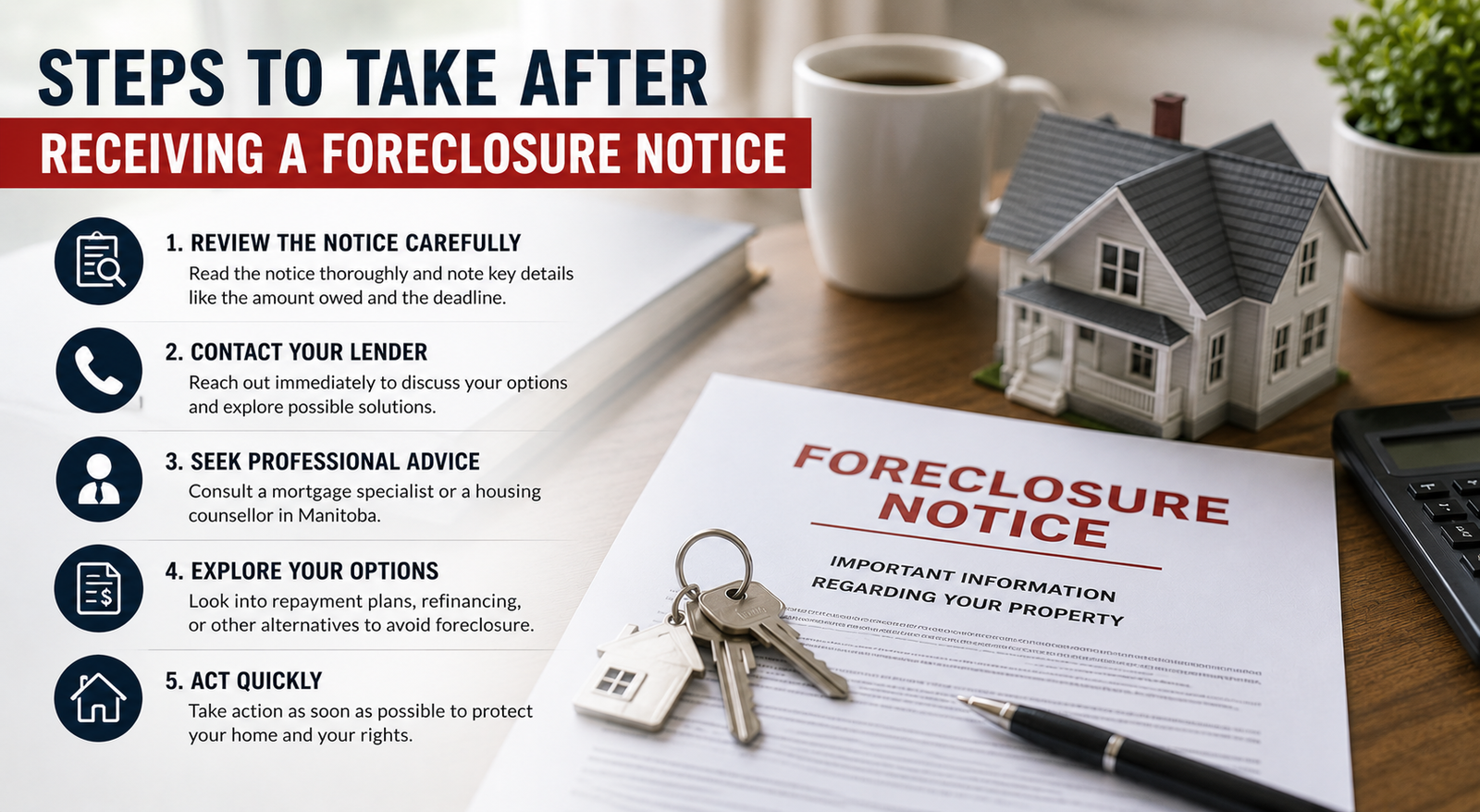
1. Don’t Ignore It
The absolute last thing that you want to do is ignore the notice and wait for the problem to fix itself. Manitoba has a number of very important timelines that regulate when action must be taken regarding a foreclosure in that province. A Statement of Claim must be responded to within 20 days if you are a resident of Winnipeg or 30 days if you reside outside of Winnipeg. If you do not respond within either of these periods, you could suffer a default judgment being entered against you.
2. Contact Your Lender Immediately
Most of the time, lenders want to find a way for you to be able to pay off your loan instead of having to toss you into court. Contacting your mortgage company right away and inquiring about options such as:
- Loan deferments or payment plans — meaning temporarily stopping or reducing payments
- Mortgage modifications — changing the terms of the loan: i.e., amount and length, to help get you back on track with making your payments
- Refinance options — if able, replacing your mortgage with one that you can afford
Many lenders have also created special programs for those facing hardship if they’ve communicated with them in a timely and sensitive manner.
3. Seek Legal Advice
An attorney skilled in Manitoba’s foreclosure regulations is knowledgeable about how foreclosure works and may be able to provide you with information concerning your right to possess the real estate; examine all relevant documents pertaining to the foreclosure; and determine if obtaining representation from a lawyer is reasonable. Legal assistance may be available if you cannot afford to retain your own attorney.
4. Explore Government and Non-Profit Resources
The residents of Manitoba may be eligible to receive financial counselling services and assistance through a number of different organizations within the area. The Credit Counselling Society provides free, non-profit services to help consumers learn how to manage their debts and negotiate with creditors; this can also relieve a potential foreclosure situation.
5. Consider Selling the Property
When you cannot catch up on your payments anymore, generally, selling your house before the court orders a court sale is the best option to go with. Selling on your own can allow you to do the following:
- Pay off your mortgage
- Possibly have something left over for yourself from the equity
- Avoid going through a damaging court-ordered sale which could potentially lose you more money than what the house is worth.
- Keep your credit report from being damaged or hurt by the full effect of a complete foreclosure.
How a Fast Cash Sale Can Help
In times when you need time soon, you cannot go the traditional real estate route of placing your house with an agent, staging your home, and awaiting offers for several months. If you choose to sell your home through a direct cash offer from a cash home buyer, you could close on your property in as few as days, whereas an agent may take months to close. This means you will have the funds- cash-on-hand- to pay off your mortgage usually before the time the court can take action against you.
Conclusion
If you are experiencing a foreclosure in Manitoba, it’s important to take action quickly. Your options may include talking with your lender, obtaining legal assistance, or finding a fast way to sell your home to avoid being foreclosed upon and to make your mortgage payments on time (so don’t put off making that choice).
If you are considering selling your home fast to avoid foreclosure in Winnipeg, I Buy Houses Winnipeg can help. They purchase homes as-is without agent commissions or hidden fees and provide sellers with an all-cash offer within 24 hours or less so that you can choose your closing date. They will manage every aspect of the deal for you, which will enable you to move forward with minimal stress and get started on a new beginning.
FAQs
Q1. I just received a foreclosure notice in Manitoba — am I going to lose my home right away?
Oh no! Getting a foreclosure notice is really scary, but that doesn’t mean you are going to lose your home tomorrow. In Manitoba, this is a court-driven process and it takes time. You will be given the ability to respond, which will be 20 days – if you are in Winnipeg – or 30 days elsewhere. That time counts, so use it wisely by calling your lender and getting lawyerly advice as soon as possible.
Q2. What if I just ignore the foreclosure notice? Will it go away?
Unfortunately, the answer is no; Ignoring this is not a good idea. If you fail to respond by the legal deadline, you may have a default judgment entered against you, which means the process will be sped up and you’ll be unable to negotiate any of the terms. The sooner you take action, the more options you’ll have at your disposal.
Q3. Can I still talk to my lender after receiving a foreclosure notice?
Definitely, step one should be to reach out to the lender directly. Most lenders prefer working with their customers by creating payment plans or deferrals instead of going through the court system. Don’t feel bad about contacting the lender, because lenders experience this type of thing more frequently than you are aware of, and several offer programs that provide assistance to customers who have a financial hardship.
Q4. Do I need a lawyer to deal with a foreclosure in Manitoba?
It’s not legally required, but it’s strongly recommended. Manitoba’s foreclosure process goes through the Court of King’s Bench, and having a real estate lawyer in your corner means you understand your rights, your deadlines, and whether fighting the claim is worth your time. If cost is a concern, look into legal aid services available in Manitoba.